Mark Twain and Philosophy by Alan Goldman
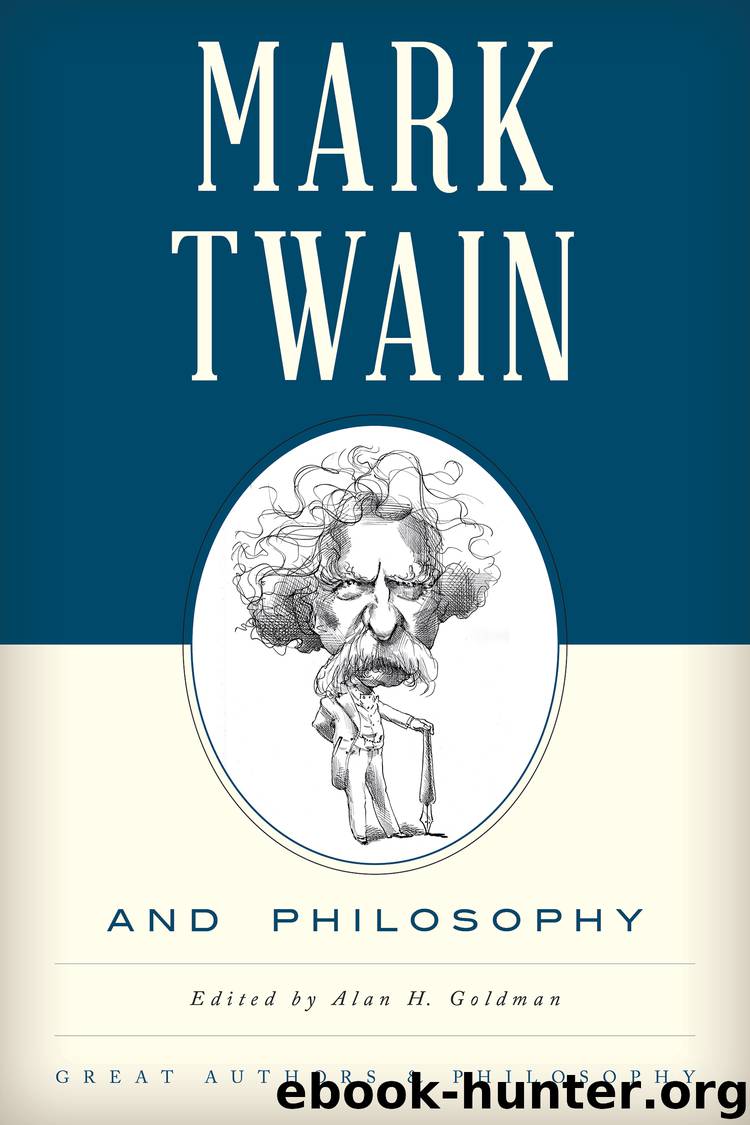
Author:Alan Goldman [Goldman, Alan H.]
Language: eng
Format: epub
Publisher: Rowman & Littlefield Publishers
Published: 2017-06-29T04:00:00+00:00
Part IV
Literary Devices
Chapter Ten
Mark Twain’s Serious Humor and That Peculiar Institution
Christianity
Chris A. Kramer
According to Manuel Davenport in his An Existentialist Philosophy of Humor, “The best humorists—Mark Twain, Will Rogers, Bob Hope, and Mort Sahl—share [a] mixture of detachment and desire, eagerness to believe, and irreverence concerning the possibility of certainty. And when they become serious about their convictions—as Twain did about colonialism [or slavery, racism, unfettered capitalism, or religion] . . . they cease to be humorous.”1 I like what Davenport has to say in the first part but not the second, as he does not provide examples of Twain’s attempts at satire that fail to be humorous. I will examine some of the very serious issues Twain addresses through humor and irony and show how his commentary and argument, though serious, is still funny while not falling into frivolity.
The Laughing Philosopher
The moniker “laughing philosopher” comes from Twain’s ability to be humorous without falling into buffoonery.2 Although he is no fan of titles,3 he might live with this one given that at least once he admitted he prefers to be considered a philosopher before being seen as a humorist.4 The title fits because he is capable of deep analysis of serious issues about human suffering while remaining in a playful attitude.5 He plays with thought not unlike philosophers who present their arguments in the form of thought experiments about serious metaphysical or ethical matters. There is something playful, if not amusing, in mulling over the possibility that we might be nothing but brains in vats, or that a famous violinist has been surreptitiously attached to our back.6
The original “laughing philosopher” was Democritus, who was also called the “mocker” as he was prone to laugh at the arrogance and ignorance of his fellow citizens. Democritus and one of his near contemporaries, Xenophanes, were both skeptical of religion and gods created in the images of men (sometimes women), yet their critiques were often lighthearted. Twain’s philosophical lineage extends back in their direction, with Schopenhauer, Hume, and Voltaire along the way. Each of these philosophers has critical insights into the religious mind, and each of them had clever rebuttals to theological dogma.7
There is a philosophical thread running through Twain’s scathing humor that attacks arrogance and a presumed sense of certitude. These two vices, arrogance and certitude, are often found together, and they are a destructive combination that sustains many of the institutions that he confronts: racism, slavery, colonialism, excesses of capitalism, and the often dogmatic, oppressive, and ludicrous nature of a great deal of organized religions.
Twain used humor as an indirect method to at once engage and disarm his audiences when submitting his blistering critiques of serious matters concerning our presuppositions and inconsistencies, which are central foci of philosophers. But the opening quotation from Davenport gives the impression that he could not mix his humor with issues that were important to him. He was either wholly serious, lacking playful humor, or he was funny, but inconsequential in his satire. Twain was aware of this dilemma:
It’s an awful thing to gain a reputation for being witty and humorous.
Download
This site does not store any files on its server. We only index and link to content provided by other sites. Please contact the content providers to delete copyright contents if any and email us, we'll remove relevant links or contents immediately.
| Anthropology | Archaeology |
| Philosophy | Politics & Government |
| Social Sciences | Sociology |
| Women's Studies |
The remains of the day by Kazuo Ishiguro(8999)
Tools of Titans by Timothy Ferriss(8393)
Giovanni's Room by James Baldwin(7346)
The Black Swan by Nassim Nicholas Taleb(7129)
Inner Engineering: A Yogi's Guide to Joy by Sadhguru(6793)
The Way of Zen by Alan W. Watts(6614)
The Power of Now: A Guide to Spiritual Enlightenment by Eckhart Tolle(5781)
Asking the Right Questions: A Guide to Critical Thinking by M. Neil Browne & Stuart M. Keeley(5775)
The Six Wives Of Henry VIII (WOMEN IN HISTORY) by Fraser Antonia(5515)
Astrophysics for People in a Hurry by Neil DeGrasse Tyson(5189)
Housekeeping by Marilynne Robinson(4447)
12 Rules for Life by Jordan B. Peterson(4304)
Ikigai by Héctor García & Francesc Miralles(4274)
Double Down (Diary of a Wimpy Kid Book 11) by Jeff Kinney(4271)
The Ethical Slut by Janet W. Hardy(4251)
Skin in the Game by Nassim Nicholas Taleb(4248)
The Art of Happiness by The Dalai Lama(4130)
Skin in the Game: Hidden Asymmetries in Daily Life by Nassim Nicholas Taleb(4006)
Walking by Henry David Thoreau(3962)
